álamos Interviews

curry, Joe -
an álamos Legend
Tuesday, December 1, 2020
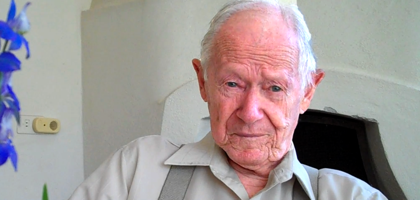
Long-time Álamos resident Joe Curry passed away in March, 2021. The article below was taken from a video interview by Joan Gould Winderman in March, 2010, with additional information added by Álamos residents Jim Swickard and Stephanie Meyer.
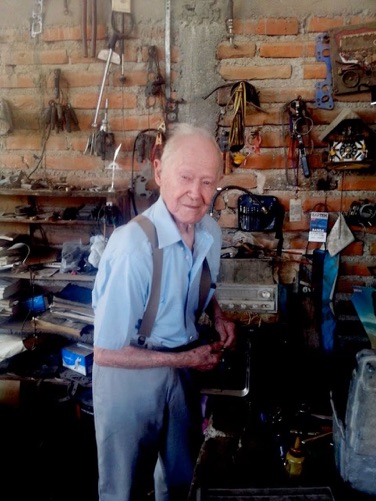
Photo@Stephanie A. Meyer
by Errol Zimmerman
from a video taken by
Joan Gould Winderman
Álamos History Association member Joan Gould Winderman began her 2010 video interview with Álamos resident Joe Curry by asking him what Álamos was like when he first came in the 1950s. Eventually he answered that question, but it was not until after he had shared many details of his exciting life of exploration and adventure. Joe Curry, who made Álamos his home since 1952, died in March, 2021, in Tucson, Arizona, at age 100.
His life story includes dropping out of medical school, serving as a pilot and bombardier in World War II, exploring unknown areas of China and South America, and walking for weeks at a time with prospecting tools and a burro, searching for and finding abandoned mines in Sonora, Sinaloa, and Chihuahua. “I explored northern Mexico,” he told Joan Winderman, “and there were no fences then. I could get on a mule and ride for months and never find a fence. I would never see anyone for weeks at a time. I’m not completely anti-social, though—only 90 percent!”
It was certainly true that he enjoyed being on his own and living off the land, but it was also true that he treasured his friendships in and ties to Álamos where he “interacted with the Mexican community more than the American community.” Directly before coming to Álamos he had been in South America, where in Brazil he had been given a land-grant to help “settle” a tributary of the Amazon River. “Those who received the land-grants and survived became wealthy,” Joe said, “but many didn’t survive. There were still head hunters there. After I married, I couldn’t take my wife into something like that.”
His wife. He talked about Berta (Olivas) often during the interview (she died in 2018), and it was meeting her that caused him to “drop his anchor” in Álamos. They became not only husband and wife but life partners in his many adventures. In the interview he said it was 1953 or 1954 when he came to Álamos and met Berta, but others have said he arrived in 1952. At any rate, he was one of only a few Americans living in Álamos at that time.
“I courted her in the traditional way,” he said of his marriage to Berta. “That required serenades, formal presentations, and a formal band through the church. Father Esparza was here at the time, and he was very strict! He didn’t even want girls wearing short-sleeved dresses. He wanted a five year band (a delay of five years before the marriage), but I had a priest friend in California—he was an Irishman and drunk half the time—who wrote him a letter telling Father Esparza I was a faithful Catholic, which I wasn’t, and we got it (the band) reduced to two years.”
While Fr. Esparza was “tough on the morals for women,” Joe said that one time he saw the Álamos priest giving a blessing for a new market with “a cigarette in one hand and a bottle of booze in the other.” While Joe didn’t use the word “hypocritical” in describing the incident, he did detect a double-standard in his behavior.
Joan Winderman asked if he had played the guitar and sung during the serenades, and Joe laughed and said that if he had, “the whole thing would have ended right there!”
“I would hire someone with a guitar and he would start playing, and soon you would see candle lights in the window. In movies the girls open the window and smile as they listen to the music, but not in Álamos. The windows remained closed.”
He added that “they didn’t think a serenade could start before midnight, and Álamos didn’t have electricity back then. Everything was dark and dead quiet—even the dogs were asleep.” Joan asked what he had paid for the serenade singer, and Joe couldn’t remember. He said at that time a daily wage was about 50 cents, so it wouldn’t have cost very much.
Marrying a Mexican citizen also meant that he had to be investigated by the Mexican government, which needed to know what type of person he was since he would be eligible for Mexican citizenship. “Citizenship requirements are much tougher in Mexico than in the U.S.,” he said, noting that you had to be sponsored by a member of Congress. He never obtained citizenship, though, since his visa allowed him to live here and do business in Mexico.
“When a government official asked me why I wanted a visa to work in Mexico, I told him I needed to feed my wife.” The official granted the visa, making the comment that he didn’t want to penalize his wife for her poor judgment in marrying a gringo.
Joe’s wife, Berta, was a formal translator for mining companies, and she worked with him to file legal documents on the abandoned mines Joe discovered. He said that she was an expert in finding out the “intent” of the document, which often went beyond the wording. She was fluent in English, also, having studied the language in school and practiced English during their many stays in the United States. When “things got slow” in Mexico, he would live in the U.S. for several months, then return to Álamos. He could always find work in northern California as a grain elevator adjustor, a job which paid $45 an hour in the 1950s.
But “exploring” and searching for treasure was his life’s work. He was proud of being a member of the Explorers Club, an American-based professional society with the goal of promoting scientific exploration and field study. Founded in New York City in 1904, it has served as a meeting point for explorers and scientists worldwide. Among its most famous members have been Sir Edmund Hillary and Tenzing Norgay, the first to climb Mt. Everest, and Neil Armstrong—the first to walk on the moon.
Membership, which comes only after an extensive investigation of your effort in the field of exploration, is extremely limited. Joe’s membership is based not only on his exploration of northern Sonora, but in the Yucatán as well as countries in South America and Asia.
Among the mines that Joe discovered and explored was the Tayopa, a Jesuit mine in northern Sonora. “The Jesuits today say they didn’t mine in Mexico, but they did. They had a clandestine operation to send metal north, across the border, and then ship it to Rome.”
In Mexico, the Tayopa has a legendary history much like Arizona’s Lost Dutchman’s Gold mine. The story begins in the 17th century when Jesuit missionaries traveled to Sonora and, while the primary goal was to spread the gospel message, they were also responsible for generating income for the church—which led to Jesuit mine ownership. When the Spanish government attempted to suppress it, the Jesuits mined in secret.
The Tayopa mine—or mines, since some reports list 17 silver mines—was operated by the Jesuits and its whereabouts were lost to history after repeated Apache raids. Checking the internet today, Tayopa—somewhere in the area near Nacozari de Garcia—remains a legend, undiscovered.
Yet Joe Curry found it.
He also found an eight-mule-load stash of eight-reales coins, most forged in the Álamos mint, under a neighbor’s house in Álamos. These coins were sold at various times to collectors in the United States, and they were found when the neighbor approached him and asked for help in searching for what was rumored to be a buried treasure. Joe said that exploring comes from fitting together pieces of a gigantic puzzle—some information here, and some information there. When those pieces fit together you can find the treasure, but people have to trust you or they won’t share the information.
The Álamos house had once been a receiving center for metals, although the main government receiving center had been out near Mercedes Ranch. It was from what is now the ranch that teams of mules left, loaded with silver, for the long trip south along the “camino real.”
Joe talked about how the “presidente” of Chínipas asked for his help in finding lost bars from a century-old robbery of a shipment of gold ore. Bandits took the gold and one bar was found near a train water station, but the rest had never been found. Joe took his equipment to Chínipas, several hours north of Álamos, and searched for a few days but found nothing. Later a new “piece of the puzzle” emerged, and Joe learned that the gold bar which was found was a decoy. He also discovered the general location of where the gold was buried, and It’s still there! It would take a massive excavation to find it, so it will probably remain where it is.
In the interview Joe talked about how a knowledge of history helps one to find a treasure. In January of 1917, for instance, British cryptographers deciphered a telegram from German Foreign Minister Arthur Zimmermann to the German Minister to Mexico, Heinrich von Eckhardt, offering United States territory to Mexico in return for joining the German cause by creating disturbances along the U.S. border. When this message was made public it embarrassed the Mexican government, and all the German Consulates were expelled from Mexico. But, through sources in Germany, Joe learned the German government had sent chocolate-sized gold bars on a ship to Guaymas to finance this operation. The ship left hurriedly after the furor, but was sunk off the Baja coast, and it’s still there—although some gold has been recovered.
Germany used the same tactic in World War II, hoping a Mexico conflict would keep the Americans out of the war. When Joe came to Álamos there was a generator and radio tower standing where the central gas station is now, built by the Germans, and from this transmitter German citizens in Álamos communicated to Germany daily. The Germans in the 1940s sent a ship—a submarine—loaded with money for the Mexican government, a ship that was spotted between Guaymas and Obregón before disappearing. From Joe’s sources, it probably sank in the Sea of Cortez.
Joe spoke about all this before he had really answered Joan Winderman’s first question, “What was Álamos like when you first came?” He said he spent his first night in the Portales Hotel, and at that time a trip from Navojoa to Álamos on the existing dirt road took from four to six hours. “That was in good weather—if it rained, it was impossible!” At that time, trips between Navojoa and Álamos were normally two-day trips with an overnight stay.
“The biggest change I’ve seen in Álamos is that they’re adopting too many American customs. It’s not the Mexico I knew originally—it’s a little United States.” When asked if this change was due to the Americans living here, he answered that there were other reasons—the internet, Mexicans going north for a time and coming back, and so forth.
“The change has not been for Mexico’s benefit.”
But, at the same time, the people of Álamos have conveniences today they never had in the past. “When I first came to Álamos most kids had no shoes, ragged clothes, and not much to eat. There were only two radio stations that you could pick up. The Álamos in those days was very poor, but now everyone has refrigerators, cars, everything.
“It was the Americans who brought the wealth to Álamos. They bought houses and paid good money for them,” while adding that restoring the houses also created job which didn’t exist before. “The Mexican population now has grown large enough and has enough money that even if the Americans left, the Mexicans could support themselves. They don’t need the Americans anymore, but at one time they did.”
When asked about the drug problem in Mexico, he said the Álamos area is a center for drugs, and that drugs had been a large source of money for a long time. Even now, though, he feels safer in Mexico that he does in half the big cities in the United States.
“Mexico thought she could handle the drug problem, but she can’t. It’s gotten out of hand. However, if Colombia can do it (solve the drug trafficking problem), Mexico can do it, too.”
“I’ve had a lot of fun in Mexico, a lot of memories. I’ve watched her change. I was really lucky to see Mexico when I first came, and I don’t know of any country that has changed so fast. I’ve enjoyed it thoroughly. I get a kick out of telling Mexicans that I’ve spent more time in Mexico than they have!
“I get along good with people everywhere—people in China, the Gobi
Desert, wherever—because I take people for what they are, not what I think they should be. And I take myself for what I should be there, too. I don’t look down on anybody and I don’t look up to anybody. I’ve got friends who are multi-millionaires, but we’re all equal friends—nothing up and down.
“I haven’t found a person in this world that can’t teach me something. If they can teach me something, then I’m not superior.”
People like Joe Curry have been a treasure to us all—a treasure far more valuable than all the silver Sonora has produced. People like Joe just don’t exist anymore.

