Álamos Interviews

Nuzum, Elizabeth
Monday, April 1, 2019
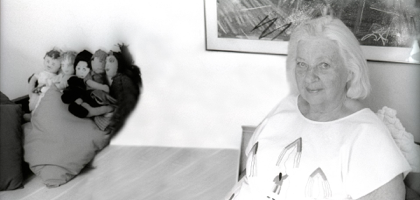
Editor’s Note: Elizabeth Nuzum was interviewed in 2005 and related highlights of her life in Álamos, which began in 1953. Following this story is an essay on Elizabeth’s many achievements in this community.
Interview
Pember and Elizabeth Nuzum bought property and moved to Álamos in 1969. They first visited the pueblo mágico in 1953, and stayed at both the Tesoros and the Portales Hotels. The Tesoros was not official open at the time, but the management fixed them sandwiches and treated them graciously. Elizabeth remembers that the rooms were heated by fireplaces.
They bought the house at #2 Comercio in 1969 from Jack and Jane Stewart. The house had not been lived in for 50 years, had earthen floors, no plumbing, no electricity, and a fallen roof. It was a total ruin.
They moved from room to room as the restoration was completed. In the spring another member of the household arrived: a tutor for their daughter, Cameron. They later bought an additional part of the house from Micha, a nurse in town. To complete the sale, they provided her with a front door, a fireplace, and a set of false teeth. It was difficult to get the deed to the additional part, but they were greatly helped by Ana Marie Alcorn.
Comercio street was of cobblestone, and the next-door property (#3 Comercio) was called the “Forum” and was a location for boxing matches. At the time there were 20 or so North Americans living in Álamos. Among them were the Summers, who lived in the Bishop’s House a few doors down from the Nuzums.
Álamos was filled with abandoned houses: many were fully furnished, and some had grand pianos, beautiful chairs, chandeliers, and other expensive items. These houses were not locked and open to all! None of these old homes, though had fireplaces.
Pember and Elizabeth painted their house green, a departure, since most of the homes were painted white at that time. (Elizabeth recalls that there may have been an ordinance requiring houses a certain distance from the church to be painted white or pastel.) In painting the inside of their house, they tried to match the original colors. The coral color in their living room had been a popular color in the Álamos homes of the 19th Century.
Ms. Nuzum recalls that Sra. Rafaela Marcor occupied a house on Obregón, now the location of the Mansión Hotel. She described Sra. Marco as being tall and elegant. In her front room she taught English and dancing, which explains the wooden floors in that room.
The Portales Hotel in those early days was the hub of activity. Managed by Bill Alcorn, people received their phone calls there and the phone number was “Alamos #1.” It also featured a fine dining room, and Polo (now of Polo’s restaurant) was a waiter.
Elizabeth Nuzum continues to live several months of each year in Álamos, although her husband, Pember, died in 2001. She is visited frequently by her son, Christopher, and daughter, Cameron. The family was very active in the community and loved and respected by both Mexicans and North Americans.
Lifetime Accomplishments and Interests
Elizabeth (“Bett” to her Tucson friends) was born in Manila, the Philippines, on May 29, 1921, and lived much of her early life in China and Japan. The American school in Kuling, the Shanghai American School (SAS) in China, Miss Blaxell’s Windsor House School, The Canadian Academy in Kobe, Japan, Fairhope School in Phoenix, AZ, National Park Seminary in Forest Glenn, MD, and Analy Union High School in Sebastopol, CA, are some of the many schools she attended. Shen then went to Scripps College in Claremont, CA, married Pember Nuzum, and later moved to Tucson AZ. She and Pember bought a house in Álamos in 1969, and after the Comercio Street house was remodeled, they brought their children and moved in. They also bought a beach house on an estuary in Sonora, and later built a straw bale house and palapa, El Pedregal, on property outside of Álamos.
The straw bale property began as an example of an inexpensive building technique for Mexicans. But, of course, it became a world-class example of a beautiful residence in a natural setting. The nature was enhanced by Elizabeth with unusual trees and shrubs. She researched straw bale construction and invited experts to Álamos as advisors. The many large rocks on the property were arranged into paths, walls, a fireplace, furniture, and a floor for the palapa. She bought and installed on the property a large scrap metal sculpture called the “Centaur,” created by Tony Estrada, director of el Museo Costumbriste de Sonora in Álamos.
This purchase was but one of the many ways she encouraged artists who came across her path. Her house on Comercio is filled with their work. Her appreciation of quality, and the time she spent sharing that appreciation with those around her, may be her greatest gift to all of us who consider her as a friend. Her continual interest in her surroundings, her voluminous reading, and her desire to learn new things are also qualities which have made all who know her consider her a treasure.
During the 20 years she lived in Tucson she attended the University of Arizona, taking course in art, children’s book illustration, Japanese, photography, jewelry making, and sign language. Later she created an embroidery class, which evolved into a needlepoint shop with Jane Harris called “The West” (Which is still functioning at River/Craycroft Roads in Tucson). It is a non-profit organization to make embroidered and other items to be sold to help unwed mothers. The Embroider’s Club (still in existence) was born out of a fundraiser for the National Cathedral in Washington D.C., of which she was a regional director for the Diocese of Arizona. She also served on the board of the Florence Crittenton Foundation, and while on the altar guild at St. Michael’s and All Angels Church in Tucson, she was active in the migrant ministry. With the Junior League of Tucson, she was the puppetry chair and attended many Puppeteers of America seminars during the summers. Her interest in helping others is further demonstrated in that after having two children, she adopted two more--and served as a foster mother to two additional children.
In Álamos, Elizabeth, along with John Lawler and George Alt, created a business to sell the work of local Mexican artisans. She served on the Board of Directors, hired Marta and Alicia as staff and taught local women to embroider designs she created. These designs can be seen today all over Álamos as well as the new designs these women have initiated. The first store was the Galería Ana Maria, a second was at the Portales Hotel, and the third was in Edith Pratt’s living room. The final store, the Artesanos de Álamos, was located in Ed Stevenson’s house on Comercio. This was expanded as she searched for craftsmen and women within a large radius of Álamos. To encourage painting among Álamos youth, Elizabeth established Saturday painting classes with the assistance of Dorothy Whitehouse.
The successful Amigos de Educación house and garden tours began when Elizabeth organized them to benefit her gift of a library. After the city government took over the library, the tour money was donated to begin a scholarship[ program which now supports more than 300 Álamos students. She is also a founding member of Las Comadres, which was organized to collect used clothing and food for distribution to the needy in Álamos neighborhoods.
Elizabeth’s close friendship with Pat Axelrod rtesulted in a design business called Milagro that she runs out of her on Comercio. Carmen and her daughter sew the exquisite clothing and decorative pillows Elizabeth designs.
Her interest in art led her to start life drawing classes with the American muralist Douglas Reisborough. Another American painter, John Trimble of San Miguel de Allende, taught oil painting to a small group as a result of her effort, and she encouraged Bernadette McAllister and Penny Crossman to hold life drawing sessions in their homes.
Elizabeth and Cammie, her daughter, developed a kite festival for Álamos which was successful for a few years, as well as a Santa Monica, CA, vs. Álamos volleyball tournament which benefited the library. Elizabeth assisted the local museum, el Museo Costumbriste de Sonora, by making is possible for director Tony Estrada to attend seminars and do course work in museum management in the United States.
Elizabeth is now in the process of designing and decorating anothyer house, purchased recently on Orcas Island, WA. She plans to live there in the summers with her daughter, Cammie, and spend her winters in Álamos.
Elizabeth Nuzum has played a vital role in this community since she and her husband, Pember, bought the house at #2 Comercio in 1969. Elizabeth now lives in Tucson, AZ.

