Álamos Interviews

Juan vidal
Monday, March 2, 2009
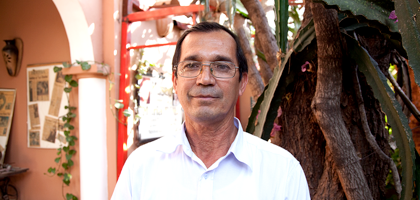
Interviewed by Ellen Price
Juan Vidal has been in Álamos for 32 years. The son of a single mother, he was born in Navojoa June 14, 1957. He has three brothers, one older and two younger. Two of his brothers are teachers, while his youngest brother is an electrical engineer in the state of Durango.
He attended school in Navojoa from his elementary years through teacher training. While he was studying to become a teacher, Juan also studied general arts. One of his teachers, Arthuro Moyers Villena, was formerly a pupil of the famous muralist José Clemente Orozco, who’s fame in Mexico is second only to Diego Rivera. Juan Vidal painted several oil and acrylic works, both portraits and landscapes, and sold them to Americans and Mexicans. Later, he decided to paint signs as they brought in more income for the family! He also studied civil law for 2 1/2 years as he was preparing to become a teacher. From 1978 through 1981 he traveled to Mazatlán to study natural science, gaining a knowledge of geology that enabled him to write the pre-history section of his 2008 book, Álamos, Century by Century. After his studies in Mazatlán, he studied languages in Guadalajara.
Juan Vidal came to Álamos in 1977 while traveling to take a teaching position in San Juan, several hours north of the city. The first evening when he arrived in Álamos, it was raining. He took shelter on the porch of the Adolfo Bley house. Teodoro Hurtado, a local guide, told him the history of the house, the plaza, and the church. All of this interested him, and he made note of the facts in a journal that he kept.
The next day he made his way to Macoyahui, next to the Mayo River. He had to stay there overnight before crossing the river to go to San Juan, and he asked about the ruins he saw there. This information also went in his notebook. The next morning he was taken to the cemetery, where he saw many old tombstones. He was told they were from the time of the Bacchomos uprising; the warriors didn’t recognize their own tribal members, so they shot each other! They were called encalzonados because they only wore calzones, a crude type of hand-stitched shorts. The Indians were in an uprising against President Porfirio Díaz, and, again, Juan jotted notes on the history of the area.
He had to cross the Río Mayo at either Macoyahui or Mexiquillo and then ride another two or three hours on a horse, mule, or donkey to reach his teaching position in San Juan. If he had to ride a donkey, the trip would take four hours because donkeys like to wander around! His first trip was difficult because he didn’t know how to ride a horse.
Juan Vidal taught all six levels of a primary school in San Juan in a one-room schoolhouse for one year. There was so much work involved that he had to teach in the afternoon, even though he was paid only for his work in the morning. He was given free housing, but the community was so grateful for his extra commitment that they gave him free food as well. He rotated from household to household, being given meals for two weeks with one family, then another. This enabled him to talk with the parents and gain much knowledge about the community.
There was no electricity in San Juan, so the men of the village used to gather around a large tree in the central plaza in the mornings to listen to a battery-powered AM radio. Juan met an old man who liked to sit under the tree and tell stories about the old times in the town. Juan wrote these stories down in his notebook; by the time he left San Juan, he had quite a collection of stories.
The next two years were spent teaching in Tabelo, north of Álamos. He had a female co-worker at the school. In his fourth year he began working at la Capilla in Álamos, teaching the early grades, which he preferred.
He was married to Juanita Grajeda, who worked as a secretary for the school district and was born in Álamos. They have four children: two boys (Luis Ángel, 25, Juan Vidal, 21) and two girls (Brenda, 14, and Jhoana, 13). Juan says they are tied--two and two--a perfect democracy! Luis Ángel was recently married with his father, the Álamos Justice of the Peace, officiating at the ceremony.
In 1989 Juan Vidal was awarded the top prize for his design of the County Seal. It incorporates symbols representing agriculture, mining, cattle, the church, Indians, coins, and arches, and it is used in official government documents.
The same year he started the music group, la Estudiantina. Juan plays the mandolin and also the accordion, and at the first the group included adults, both men and women, as well as youth. Ana Silvia Laborin, director of museums for Sonora, and Tony Estrada, director of el Museo Costumbriste de Álamos, were also instrumental in forming the Estudiantinas, now composed of young men from their ‘teens and into their twenties. They named the group in honor of Alfonso Ortiz Tirado, the famous Mexican tenor born in Álamos. Juan Vidal was director of the group, selected the music, and taught them the songs. Ramón Alcantar and Reyna Sanchez were early members, and the group has made several trips to United States--once even to San Francisco. Eventually, Juan felt he could not spend so much time away from his family and stepped down as director in 1995.
Juan Vidal has been involved with Álamos City Hall since he first began teaching in Álamos. His interest and knowledge of local history became known, so he was asked to make presentations and work with city officials. Five years ago he began his duties as Justice of the Peace, balancing this position with his work with the teachers’ union and city hall. He retired from education two years ago, and now his duties include registering births, deaths, marriages, divorces, adoptions, and recognitions (the father of the child registers his surname. Juan also performs civil marriage ceremonies.
Juan Vidal published his book, “Alamos, Century by Century”, in 2008. The book covers 320 years of history starting with the first baptism in the Álamos church in 1685. Some of the events tell of dark times in the early 1900s until the end of the Revolution, the installation of telephone and telegraph in 1881 and 1883, the establishment of a hospital in 1887, the opening of the Mercado in 1895, the building of the Palacio in 1899, and the inauguration of the railroad in 1908. The completion of the highway to Navojoa and land distribution to indigenous populations, ejidos, occurred in 1960.
“Álamos of Yesterday” is a new book that Juan Vidal has finished and will soon be published. The book contains many old photographs, some from more than a century ago. Juan gathered these photos from his friends in the community. He also has one more book that he hopes to publish--a book representing a chronology of events throughout the calendar year, taking each day and looking at what events took place on that day. He says that it will probably be his children who publish this latest book.
Juan Vidal has published a book on the history of Álamos entitled “Álamos, Century by Century.” He has a second book ready for publication and is working on several more.

